
Over the past few years, I’ve watched my front lawn grow increasingly patchy and yellow, particularly during the summer months. Keeping a lush green lawn feels harder than ever — demanding constant watering, feeding, and care. For me, personally, a traditional lawn has never been a high priority. I’d much rather see borders alive with texture, colour, and movement — and a garden that feels more connected to nature.
So, when I came across a post by John Little, where he transformed his son’s lawn by covering it in sand and sowing Californian poppy and other meadow plants, I was instantly intrigued. His approach looked beautifully unforced — a garden that celebrated resilience over perfection. It inspired me to rethink my own space and experiment with an emerging method of planting that is gaining a lot of attention in contemporary garden design: sand planting.

What Is Sand Planting?
The principle behind sand planting is simple yet surprisingly radical — instead of planting directly into fertile topsoil, you create a layer of sand or fine aggregate and plant directly into that. The idea has been pioneered by Swedish plantsman and designer Peter Korn, often referred to as “The Sand King” for his extensive use of sand in both public and private projects. Korn has even planted successfully into crushed concrete and brick, proving that richness of soil isn’t always the key to a thriving garden.
Here in the UK, designers and gardeners such as Tom Stuart-Smith and Charlie Harper have adopted similar approaches, most notably at the Knepp Estate. Their sand and recycled concrete garden has become renowned for its beauty and biodiversity — a new kind of ecological planting that thrives in dry, lean conditions.
Designer Sarah Price has also spoken about the benefits of growing in sand and aggregate rather than soil. As she puts it, plants “grow harder” under these conditions, which helps prevent dominant species from taking over. This creates greater diversity per square metre — ideal for those of us who love a naturalistic, meadow-style aesthetic.

Taking the Plunge
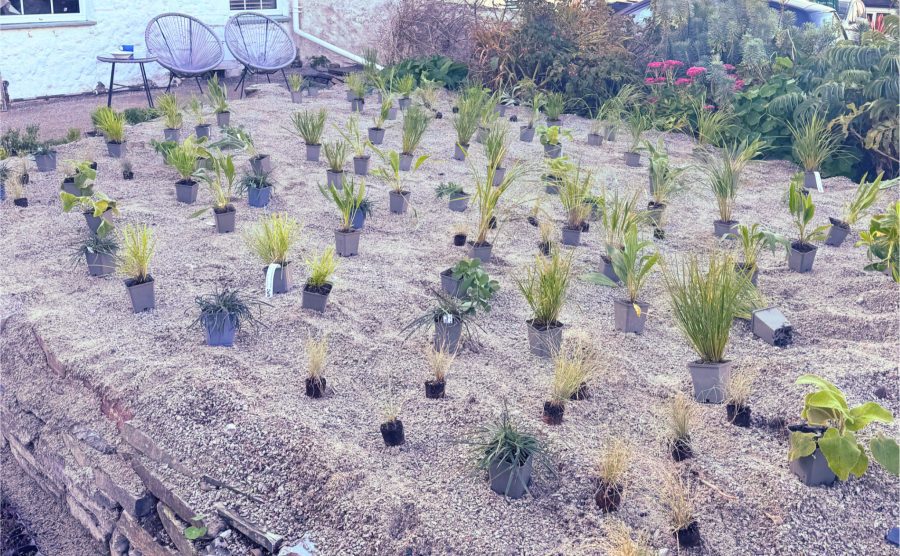
Encouraged by what I’d seen and read, I decided to take the plunge. We covered the existing lawn with around 150 mm of 0–6 mm granite aggregate, slightly thinner in a few places. The look was certainly stark at first — all grey and minimal — and I did have a brief moment of panic that I’d created a beach instead of a garden.
Then came the planting. I chose a diverse mix of perennials that I knew would thrive in poorer, free-draining conditions:
Echinacea pallida, Dianthus, Centranthus alba, Centaurea, Lychnis coronaria alba, Perovskia, Oenothera, Gaura, Salvia ‘Royal Bumble’, Origanum, and Phlomis russeliana.
For structure, movement, and texture, I added grasses such as Pennisetum, Sesleria, and Calamagrostis.
Early Results
The garden was planted in early September, and already there are promising signs. The perennials have settled in and are starting to root deeply into the aggregate. A few — including Salvia, Cirsium, and Gaura — have even produced a scattering of late-season flowers, softening the gravel and hinting at what’s to come.
What’s most striking is how quickly the garden has begun to find its balance. The grey granite now contrasts beautifully with the new green growth, and as the plants expand, the overall look is beginning to shift from sparse to sculptural.
Looking Ahead
By next summer, I’m hoping this space will have transformed into a soft, textural planting that feels both natural and intentional – a rich and interesting meadow right in front of our old cottage.
Beyond the visual transformation, this experiment has changed how I think about what a garden can be. A green lawn once symbolised care and order; now it feels like a relic of a different climate. In contrast, this sand-planted approach offers resilience, sustainability, as well as really interesting and beautiful planting schemes.